
Lydiard Experiment #1: A Foundation of Health
An exploration of the training framework set forth by Arthur Lydiard, starting with the bottom floor of his pyramid.

Our family just got back from a holiday ski trip to northern Vermont. I’m not much of a skier, but I do my best to be a Sherpa for our kids. Due to icy conditions — walking to the parking garage from the hotel was treacherous enough — on this particular trip I was treadmill bound. The hotel gym had Star Trac treadmills facing a yellow-orange wall. I have yet to come up with a Jedi mind trick where I can avoid an intimate connection with the second-by-second passage of time that occurs for me on a treadmill 12 inches from a bland wall.
Anyways…
I want to write a comprehensive profile on the late Arthur Lydiard later in this newsletter, probably as a series, because his effect on how distance runners train has been so extraordinary over the last half-century.
It's worth noting up front that Lydiard built more of a framework for distance training rather than a one-size-fits-all plan. It might be fair to say that considering how each individual runner is “an experiment of one” — as the Lydiard Foundation likes to emphasize — it’s logical to think that the ideal Lydiard plan is one that has been customized for each runner taking it up.
The first time I trained for a marathon was in 1989-1990. I bought a book for $10 (Galloway’s Book of Running) that featured one of the many iterations of Lydiard’s training philosophy that existed then and exists now.
Galloway’s was a simplifed version of Lydiard. It was about six months long as I recall and included a base phase, a short hill phase, and a “speed” phase. The heart of the program was taking your Sunday run and incrementally increasing it by a relatively small amount each week. I probably started with a five or six mile run and each week took it up a mile until I got to 12 miles per week. Then the increases came every two weeks with a maintenance long run between. Galloway (as I recall) had me build up to a 20-plus mile long run. It may have capped at 22 or 24. I don’t have the log from back then but that’s what I remember.
It worked pretty well. I ran the 1990 Big Sur Marathon in 3:24:26. Using roughly the same plan, I returned to Big Sur the next year and ran around 2:53:50, good enough for 31st place.
From that point in time, I started testing out other interpretations of the Lydiard model. In particular the Dr. Joe Vigil model (think Olympic bronze medalist Deena Kastor, the late Pat Porter and the legendary years of the Adams State cross-country and track program) and the Bill Squires model (think Bill Rodgers). In both cases, I had mixed results. To sum it up, they were both extremely potent and effective in improving aerobic capacity and performance, but because I went into them with sub-optimal physical health, I got constantly got injured. I was only able to race occassionally, eeking out a 2:38 marathon once, but injuries forced me to the sidelines way too often.
What I never did in my peak marathon years (or otherwise) was follow Lydiard’s orginal program. I can’t say I ever knew what it really was outside of the base phase, hill phase, speed phase.
From what I’ve been learning, if I had followed a closer, more thorough interpretation of Lydiard, I most likley would have 1) achieved better performances and 2) had many more years of good racing before getting tangled up in a web of chronic injuries.
The classic Lydiard pyramid includes additional levels beyond aerobic/hill/speed, according to what I learned in the Lydiard Foundation coaching program.
Here’s a look:
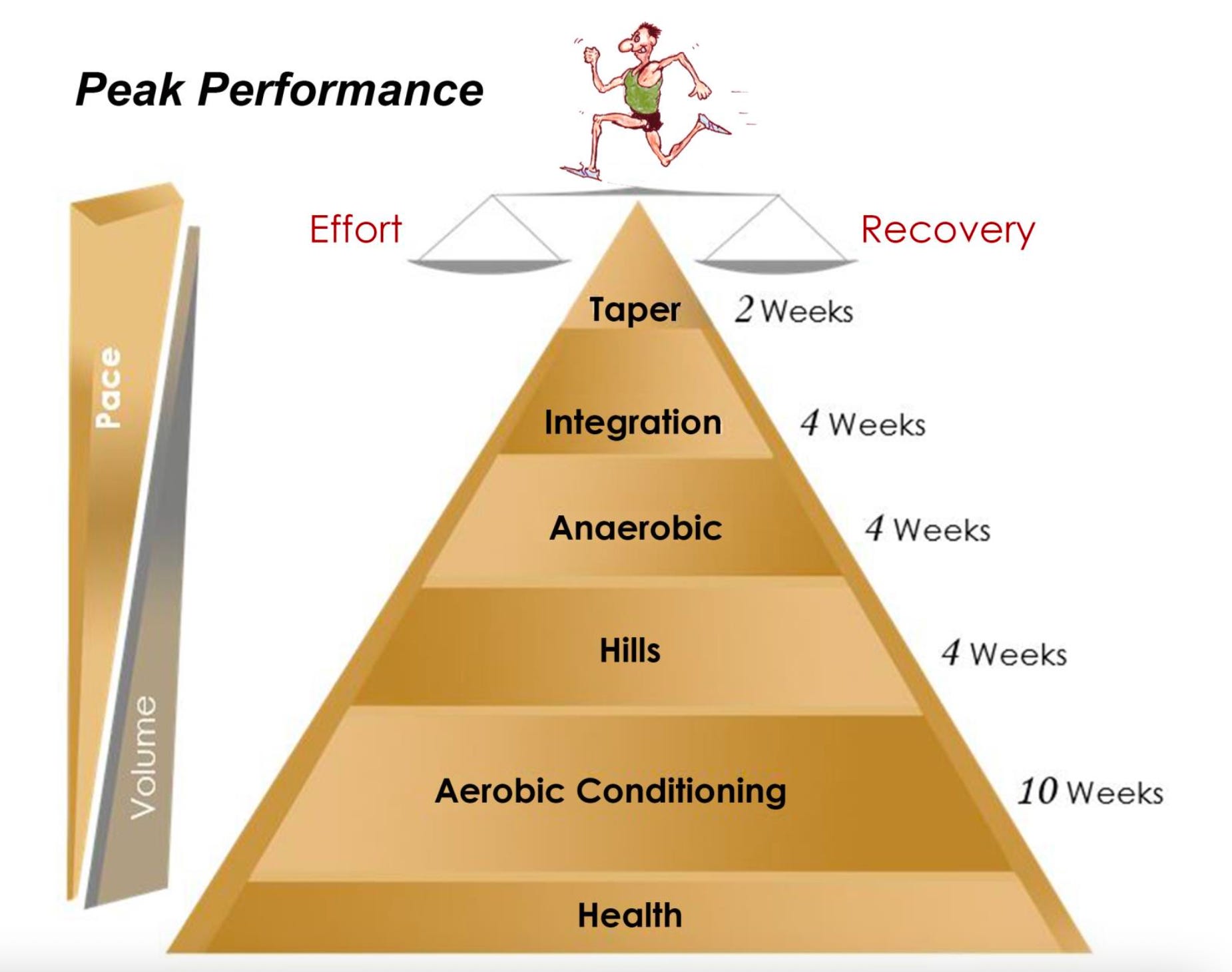
Notice the base of this pyramid. Health.
One thing I’ve come to understand in a visceral way, both with myself and with runners I’ve coached, is how crucial this “Health” level is to any interation of Lydiard and logically any running program out there. It’s common sense, or should be common sense. To take it for granted is to doom yourself to trouble. But I know I’ve tried to train through injuries and sickness more times than I care to remember. And I know I never emphasized health as a key phase of training.
I’ve also come to understand that “health” is best defined at more than just the absence of injuries or illness. Good health can also refer to areas like top metabolic health, top mental health and top musculoskeletal health. Each individual likely has his or her own definition of optimal health and what the markers for that health happen to be.
Jacking each of those areas up through nutrition, strength training, good sleep and stress management is most potent foundational level of training.
For example. I know in the past I seemed to believe that running a lot was a ticket to eat whatever I wanted. I’m not the only runner guilty of this assumption. Definitely this is something you can get away with more easily when you’re younger but tougher when you’re older. Impossible for me. Poor nutrition equals chronic inflammation for me, which means I’m ripe for injury.
And even though you can appear to get away with poor nutrition habits when you’re a young runner, it’s almost certainly undercutting your potential performance.
Sleep and stress should not be ignored either. Again, common sense suggests this. But unless you’ve been burned by mistakes enough, these don’t necessarily become the priorities they should.
Chasing performance is much more fun and motivating than chasing health and wellness. Years ago I interviewed Dr. Barry Sears, author of the bestselling Zone diet books, and he talked about his experience in trying to motivate people to improve their health and wellness through an anti-inflammatory diet and corresponding lifestyle choices. Like sleep and exercise. Sears described people tuning out, eyes glazing over as they started thinking about othere things, like what might be on TV or if there might be a sale at Macy’s. BUT — talk about improving performance, and people lit up and tuned in, hungry for information and guidance.
So the self-motivation trick here is to know that if you want to build the best pyramid you’re capable of the more health foundation you have to work with the higher you can go.
In the coming weeks, I’ll explore this level of the Lydiard pyramid in detail and how to go about building it into a program in a time- and cost-efficienct way.